





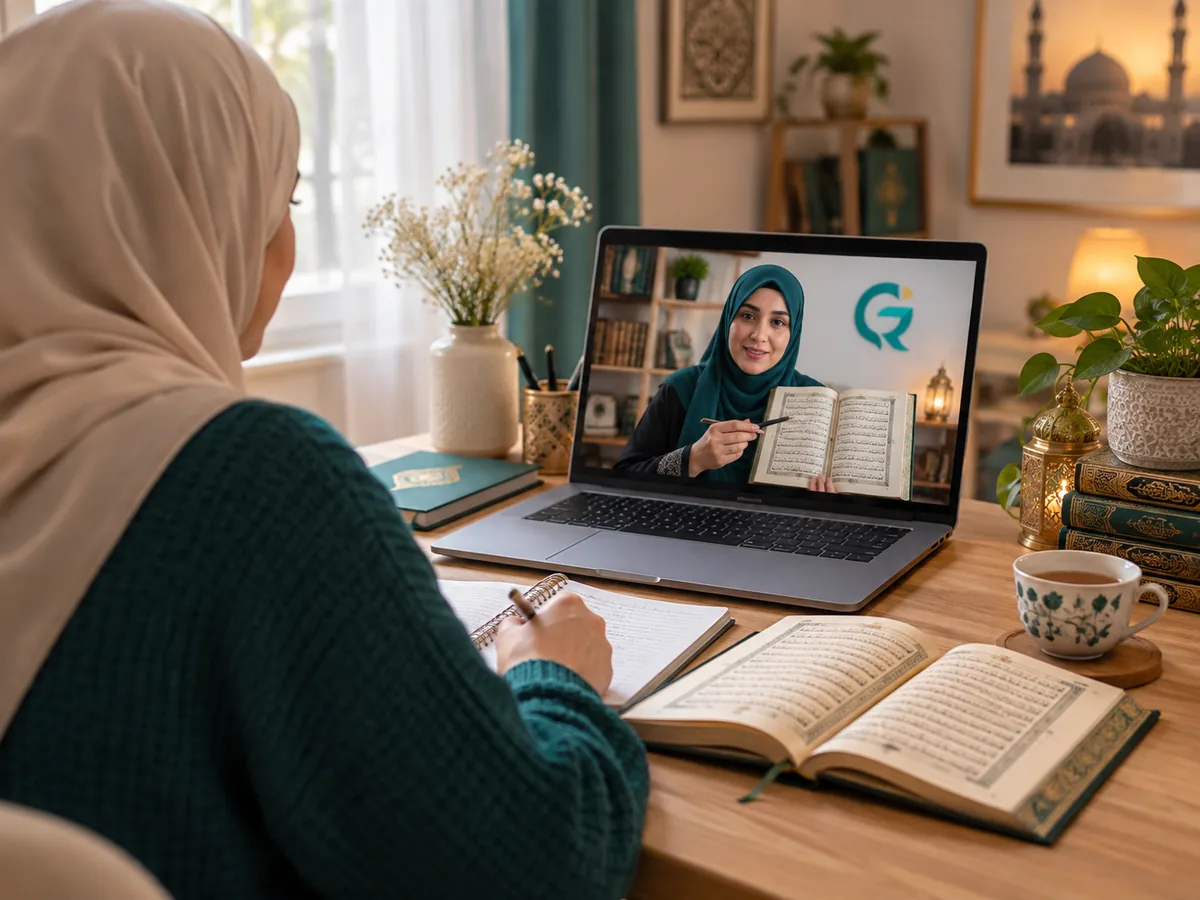
A beginner’s online Quran lesson should usually start by finding the learner’s real level, not by assuming that every beginner needs the same first page. The teacher may check letter recognition, short-vowel reading, blending, previous memorisation or recitation habits, then choose one manageable target for the session. The lesson is interactive: the learner reads or responds, the teacher listens, corrects and adjusts the next step.
The first minutes are for orientation
For a new learner, the teacher needs a quick picture of what is already secure. A child who knows Arabic letters but cannot blend them needs a different starting point from an adult who can read slowly but makes recurring pronunciation errors.
One clear skill usually becomes the lesson focus
A productive beginner session does not try to fix everything at once. It may focus on a small set of letters, a vowel pattern, joining sounds, a short reading line or one recitation habit. Keeping the target narrow makes correction easier to remember.
The How We Teach page describes Quran Garden’s wider teaching approach.

The learner must do more than watch
Online teaching works when the student is active: reading aloud, identifying a letter, repeating a corrected sound, recalling a short passage or answering a simple question. The screen is only the connection; the learning comes from guided practice and feedback.
Correction should be immediate but selective
A teacher can stop every minor mistake, but that may overwhelm a true beginner. It is often better to correct the error that blocks the current skill, let the learner try again, and return to secondary details later. Repetition after correction is important.
The pace changes with age and concentration
A young child may need shorter tasks, visual variation and more frequent turns. An adult can often sustain a longer explanation or practice sequence. The online learning for different ages and levels explains how online learning can be adapted for different ages and starting points.
The lesson should end with a concrete next step
A beginner should know what to practise after the call: a few letters, one line, a short repetition cycle or a recording to review. Homework does not need to be large; it needs to match what was actually taught.

What parents can observe in a child’s lesson
Look for whether the child is being asked to respond, whether corrections are understandable, and whether the task matches attention and level. A good lesson should make the next step clearer, not leave the child with a long list of unrelated errors.
The How We Teach provides additional context on the teaching method.
An online Quran lesson for a beginner is not simply a video call with a textbook. It is a cycle of level-checking, focused practice, listening, correction and a small next step. When those parts are clear, the format can feel structured even for someone starting from zero.