





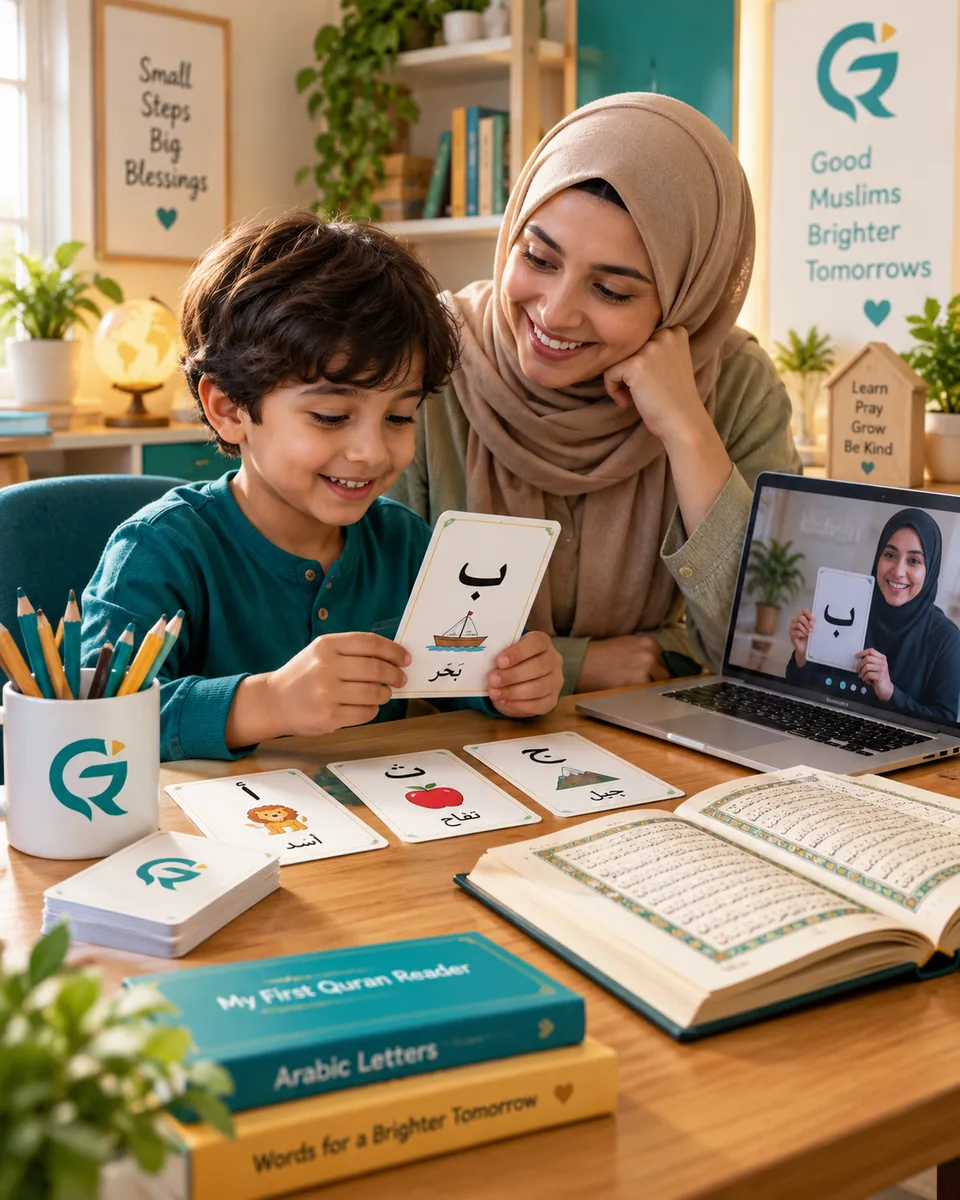
Children usually learn to read Arabic more smoothly when the path moves through clear layers: recognising letters, connecting shapes to sounds, reading short vowel patterns, noticing joined forms, blending into words and only then handling short sentences with confidence. Skipping a weak layer usually makes the next one feel harder than it needs to be.
Start with a small working set of letters
A child does not need the whole alphabet mastered before any reading begins. A small group of well-known letters can be used for recognition games, sound practice and simple combinations. Add new letters gradually while continuing to revisit the earlier set.
The important point is retrieval in mixed order, not merely repeating a memorised alphabet sequence.
Teach the sound as part of the letter
When a child sees a letter, the route to its sound should become direct. Keep explanations short and give more time to hearing, saying and identifying. Similar-looking letters need deliberate contrast so the child learns which visual details matter.
If the family is deciding whether the goal is Quran reading or broader Arabic language development, this comparison of the two learning paths helps clarify the difference.
Bring in vowels and short sound units
Short vowels turn letter knowledge into readable units. Practise one pattern, mix it with familiar letters, then change the vowel. The child should learn to look at the whole unit rather than naming the letter first and decoding the vowel afterwards.
Use quick practice rather than long drills. Several successful minutes repeated across the week are usually more useful than one exhausting session.
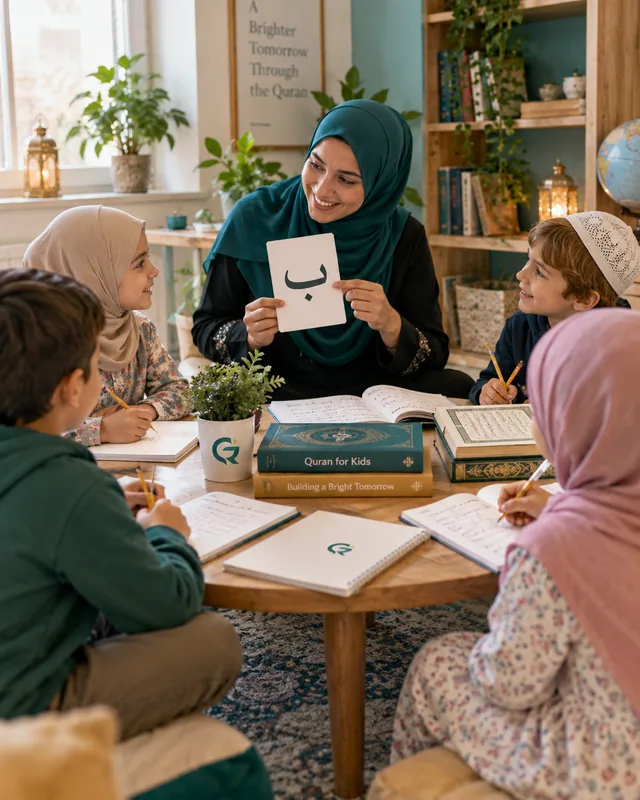
Introduce connected forms before they feel surprising
Arabic script changes shape when letters join. Show the same familiar letter in more than one position and ask the child to find what stayed the same. Tracing, matching and highlighting can help, but the activity should always return to actual reading.
The Arabic Reading for Kids programme is the relevant pathway when a child is ready to develop these skills through guided reading.
Move from blending to meaningful words
Once the child can combine short units, use simple words that contain known letters and patterns. Meaning can support memory, but do not encourage guessing from a picture or context. Ask the child to read the word first, then connect it to meaning.
This keeps reading based on the script while still making Arabic feel like a language rather than a code exercise.
Add short sentences only when words are stable
A sentence adds several demands at once: keeping place on the line, moving between words, maintaining vowel attention and remembering meaning. Begin with short sentences that recycle familiar vocabulary. Let the child reread the same sentence until the second attempt feels easier than the first.
The broader Arabic Language Curriculum provides the wider pathway beyond early reading, including vocabulary and language development.

Keep correction selective
If every small hesitation receives immediate correction, the child may become dependent on the adult. Choose the most important error, give time for a second attempt and notice whether the child can self-correct. Self-correction is a useful sign that reading processes are becoming independent.
What parents can track
Watch four things: recognition, blending, connected forms and stamina. A child may be strong in the first three but still tire after a few minutes. That does not necessarily mean the material is too difficult; it may mean the session should stay short while reading endurance grows.
Keep a simple note of recurring confusions and share it with the teacher rather than changing methods each week.
A realistic progression
A child who can recognise letters but cannot blend needs blending practice. A child who can blend but is confused by connected shapes needs more visual work. A child who reads words accurately but very slowly may simply need repeated reading of familiar material.
Step-by-step progress works because each new task rests on something already available. The goal is not to race through books. It is to help the child reach the point where Arabic print begins to make sense with less and less adult prompting.