





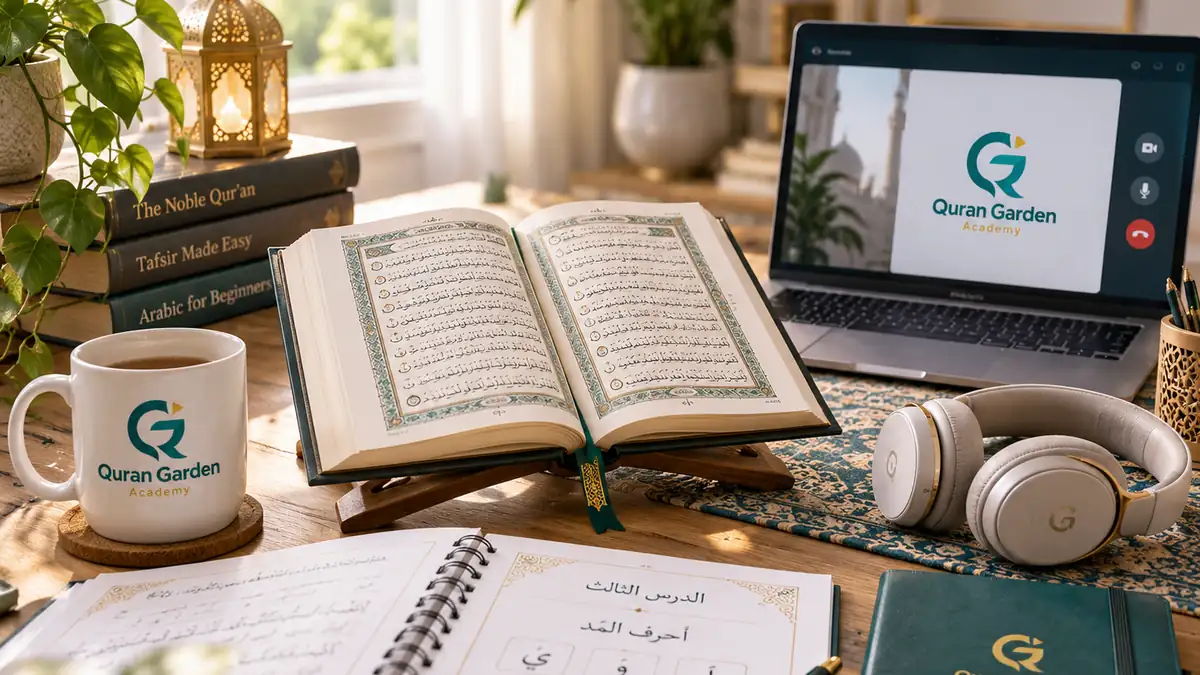
The curriculum in brief
Quranic Arabic Curriculum
This curriculum helps learners notice how Arabic words and structures behave in Quran-related text. It develops vocabulary, morphology and sentence recognition so repeated language becomes easier to follow, while keeping language learning distinct from authoritative Tafsir.
Language study is kept distinct from claims of Tafsir authority.
How the curriculum develops
Recognise recurring vocabulary
Build a useful base of words and particles that appear frequently in Quran-related study.
See word patterns
Notice roots, common forms and changes that help identify relationships between words.
Read sentence structure
Recognise basic grammatical relationships without turning every passage into a long grammar exercise.
Follow more independently
Use vocabulary and structure together to understand more of what is being read before consulting explanation.
What stays in focus
Recurring Quran-related vocabulary
Word forms and roots
Sentence recognition and careful language analysis

How lessons work inside this curriculum
A word, pattern or grammar point is introduced and then used immediately in reading, listening, speaking or a short writing task. The mix changes with the curriculum goal, but recognition is always pushed toward usable language.
Between lessons
Practice may be vocabulary retrieval, a short reading, a listening task or a few sentences. It is chosen to strengthen the skill currently being built rather than to fill a worksheet.

How the teacher adapts the path
The teacher adjusts how much Arabic is used in the lesson, how much grammar is named, and whether the learner needs more listening, reading or production.
What the learner should be able to do
Recognise more repeated vocabulary without translating every word
Use common word patterns to make better sense of unfamiliar forms
Follow basic sentence relationships with greater independence
Useful questions before starting
Is this a Tafsir curriculum?
No. It is an Arabic-language curriculum. Tafsir requires its own scholarly method and sources.
Do I need advanced grammar first?
No. Grammar is introduced in the amount needed to understand the structures being studied.
Will this replace a translation?
No. It aims to improve direct language recognition, while translations and explanations remain useful tools.
Do I need to read Arabic before starting?
Not for foundation curricula. Reading ability is part of placement.
Is speaking included?
Yes when speaking serves the curriculum goal; Quranic Arabic places more weight on recognition and understanding of Quran-related language.