






If your main goal is to understand the Quran, study Arabic with Quranic vocabulary and structures at the centre of the course. If your goal is broader formal reading and writing in today’s Arabic-speaking world, Modern Standard Arabic (MSA) deserves more space. The two are not unrelated languages, so the choice is not “one forever or the other forever”. It is a decision about what you want your first months of study to prepare you to do.
First, clarify the labels
“Quranic Arabic” usually means study focused on the Arabic of the Quran and the classical language needed to work with it. “Modern Standard Arabic” refers to the contemporary formal register used widely in education, books, news, formal writing and public communication.
They share the Arabic script and a large grammatical and lexical foundation. The difference that matters to a beginner is mainly where the course directs your attention.
A Quran-focused course gives priority to recurring Quranic vocabulary, morphology, grammatical patterns and the way meaning is built inside Quranic passages. An MSA course gives more room to contemporary vocabulary, modern reading topics, writing tasks and formal communication.
Compare them by learning goal, not by prestige
| Your main goal | A sensible emphasis |
|---|---|
| Understand Quranic vocabulary and sentence structure | Quranic Arabic first |
| Read contemporary formal Arabic | MSA first |
| Study both Quran and modern Arabic seriously | Shared foundation, then two strands |
| Speak naturally with people in one region | MSA plus a relevant spoken dialect |
This does not mean a Quranic Arabic learner gains nothing useful for MSA, or the reverse. It means the fastest path to a specific goal gives that goal priority.
If Quran understanding is your main reason for learning, the Arabic for Quran programme is the more direct commercial path on this site.
What overlaps?
A beginner in either path still needs to read Arabic script, recognise common word patterns, understand how words change, and build a basic grammatical framework. Nouns, verbs, particles, sentence relationships and root-based vocabulary matter in both.
That shared foundation is useful because it prevents an unnecessary fear that choosing one path will make the other inaccessible. A learner who studies Quranic Arabic carefully is still learning Arabic. A learner who studies MSA is still building knowledge that can later support classical reading.
The overlap, however, should not be exaggerated. Knowing how to read a modern news paragraph does not automatically teach the specialised vocabulary, rhetorical density or interpretive context required for Quran study. Likewise, recognising Quranic vocabulary does not automatically give you the language needed to write an email, follow current affairs or discuss modern topics.

How Quranic Arabic changes the vocabulary you learn first
A focused Quranic course usually gives priority to words and roots that recur in the Quran, grammatical structures that appear frequently in the text, and the ability to analyse how endings and word forms affect meaning.
This changes the examples used in lessons. Instead of spending early units on travel, shopping or office vocabulary, the learner may work with words connected to guidance, worship, creation, accountability, family, belief and other recurring Quranic themes.
The Quranic Arabic curriculum is designed around this kind of goal-focused progression.
What MSA adds
Modern Standard Arabic broadens the learner’s ability to work with contemporary formal Arabic. You are more likely to meet current vocabulary, modern prose styles, practical writing and reading material from education, media, public life and general non-fiction.
If you want Arabic to function as a living formal language beyond Quran study, this matters. A Quran-only vocabulary plan can leave large gaps in ordinary modern subjects. An MSA learner, meanwhile, may need additional Quran-focused work when moving into classical passages.
On Quran Garden, the broader Arabic Language curriculum is the better reference point for that wider goal.
Three learner profiles
“I mainly want to understand what I recite”
Start with Quranic Arabic. Build reading, high-frequency vocabulary, morphology and the grammar needed to unpack short passages. Add wider MSA later if your goals expand.
“I want Arabic for study, reading and formal communication”
Start with a broad MSA pathway. Keep Quran study as a separate strand so that sacred-text vocabulary and classical structures receive dedicated attention.
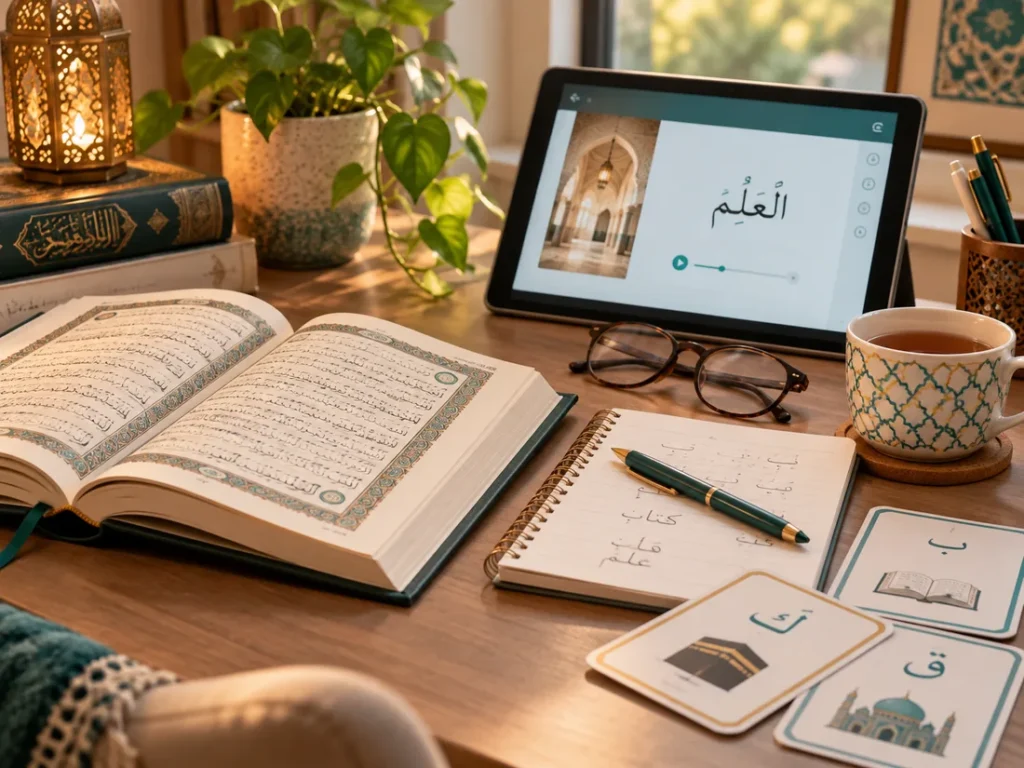
“I want both and I have time for a long-term plan”
Begin with a shared foundation, then divide your study. For example, one part of the week can develop modern reading and writing while another works through Quranic vocabulary and structures. This is often more realistic than expecting one textbook to serve both goals equally well.
What about spoken Arabic?
Spoken dialects answer another question: how people communicate in daily life in particular regions. If conversation with family, travel or living in a specific country is important, a dialect may eventually become part of the plan.
Do not confuse that decision with the Quranic-Arabic-versus-MSA decision. A learner can study Quranic Arabic for text understanding, MSA for formal reading, and a dialect for everyday conversation. They serve different jobs.
How to choose without overthinking it
Write one sentence beginning with: “In twelve months, I want Arabic to help me…”
If your sentence ends with “understand Quranic words and grammar”, choose a Quran-focused path. If it ends with “read books, articles and formal modern Arabic”, choose MSA. If it includes both, accept from the beginning that your curriculum needs two priorities rather than one vague course called “Arabic”.
The choice can be reviewed later. You are selecting a starting emphasis, not signing a permanent contract with one register of the language.
For a Quran-centred route, compare the Arabic for Quran programme with the broader Arabic curriculum before deciding. A clear goal will save more time than searching for a supposedly perfect variety of Arabic.