






Yes, a learner can make meaningful progress in Quranic Arabic without becoming a fluent Arabic speaker. Reading comprehension and spontaneous conversation overlap, but they are not the same skill. A person may understand familiar Quranic structures while still finding everyday conversation difficult.
Separate your goal from a general fluency goal
If your priority is Quran comprehension, you need reliable reading, a growing Quran-focused vocabulary, awareness of common word forms, and enough grammar to follow relationships inside a verse. Speaking practice can help, but it does not have to be the centre of the plan.
The Quranic Arabic Curriculum is built around this reading-and-understanding pathway rather than treating spoken fluency as the only sign of progress.
What you still need to learn
Avoid replacing spoken fluency with a shortcut. Quranic Arabic still requires careful study. You need to recognise pronouns, particles, verb patterns and sentence structures, and you need to learn how meaning changes with context.

A learner who knows many translated words but cannot see who is acting, what a pronoun refers to, or how a clause connects may misunderstand the passage. Grammar and morphology therefore remain practical reading tools.
Speaking can support comprehension without becoming the target
Speaking develops speed of recall, listening and confidence with Arabic patterns. Those benefits can support reading, even if your main aim is not conversation. Short pronunciation practice, reading aloud and simple sentence work may be enough for some Quran-focused learners.
Quran Garden’s Arabic for Quran programme can be useful when the learner wants a guided route that keeps comprehension at the centre.
Expect uneven strengths
It is normal to understand a familiar verse more easily than an everyday conversation, or to recognise a word in writing but struggle to produce it aloud. Different skills grow at different rates. Judge progress by the task you are training for.
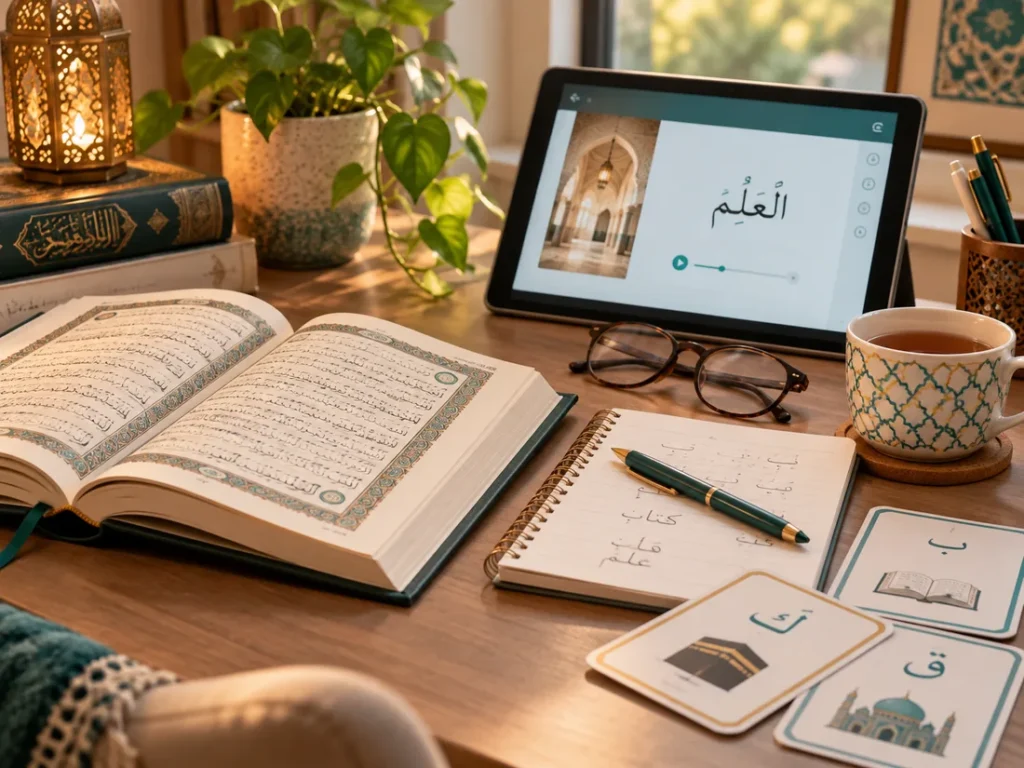
The broader Arabic Language Curriculum is more appropriate if you later decide that listening, speaking, writing and general communication should grow alongside Quran comprehension.
Build a focused but complete pathway
A Quran-focused plan can include reading accuracy, high-frequency vocabulary, basic morphology, essential grammar and regular work with short passages. Add speaking as a support when it helps, not as a condition that must be completed before you are allowed to understand the text.
The useful question is not whether you sound fluent in conversation. It is whether your understanding of Quranic words, structures and relationships is becoming more accurate, more independent and more consistent.